
Pages

Samsung TV Catalog 2018


Until today, Samsung has been playing it coy with its 2018 TV line-up: It teased that QLED TVs would make a comeback this year but, back at CES 2018, Samsung only had two new TVs to show off – the 8K-capable Samsung Q9S with AI upscaling and The Wall, a 146-inch modular TV that harnesses the power of MicroLED.
Both TVs, while certainly beautiful in every aspect, are only affordable for the most affluent of TV enthusiasts. So, what can the rest of us plebeians expect from Samsung in 2018? 
For the main swath of TV buyers, you can look forward to four new series of QLED (the Q9F, Q8F, Q7C and Q7F) plus the entry-level Q6F QLED that debuted around the holidays in November of last year. Further down the line will be Samsung’s new UHD models that will be prefaced with the new NU- distinction and, at the very end, traditional HD TVs and Samsung's luxury design series from last year. 
With so many models to take in, we thought it'd be beneficial for to see the entire line-up, from the high-end QLED to the entry-level TVs, all on one page. 
It’s worth noting that a lot of the specs listed below could potentially change as we get closer to the retail release of these screens, but for the most part the specs you see here should be the components that make it in the final product. 


Samsung 2018 TV technology

Because Samsung’s 2018 TV catalog is all over the place in terms of performance and price points, it’s hard to find one definitive incremental update that will touch every TV in the line-up – technologies that work for the 146-inch modular TV probably won’t apply to a 49-inch UHD TV and vice-versa.
That said, if there was one unifying technology that should touch all the models in one way or another, it’s the introduction of Bixby – Samsung’s virtual assistant – into every model in the QLED and MU- Series line-ups. 
The addition of Bixby will help bring Samsung 2018 TVs closer in line with some of the better video streaming players out there, the Apple TV 4K and Amazon Fire TV, each of which have their own smart assistants on hand to help you track down content and answer any questions you have. 
The addition of Bixby will also allow the TVs to be compatible with Samsung’s SmartThings smart home platform. Together, Bixby and SmartThings will allow you to control your home from the comfort of your couch, giving you voice control over everything from smart lights to your Samsung SmartThings-enabled refrigerator. This may not be as beneficial for those folks who aren’t quite ready to buy into smart home tech yet, but it’s a nice addition to those of us who already have.
Of course, the star of the show for Samsung in 2018 is still the QLED TV screen – essentially a variation on traditional Quantum Dot LED-LCD panels that feature a peak brightness between 1,500 and 2,000 nits. For a reference point, that’s about twice as bright as the competition from 2017 and four to five times as bright as the HD/SDR TV you’re used to watching. 
For 2018, Samsung says it will be improving the black level performance of its QLED TVs – ideally bringing them down without trading any of its signature brightness. If it can pull this off, you’ll see a much better contrast ratio and better visual fidelity for 4K/HDR content. (Remember, Samsung TVs support two kinds of HDR right now, HDR10 and HDR10+.) 
The last new feature Samsung announced is its new Ambient Mode. When the TV is turned off, Ambient Mode will help the TV mimic the color and pattern of the wall on which the TV is displayed, so that it blends seamlessly into home décor. It can also play music and display information about the news, weather, and traffic as well.

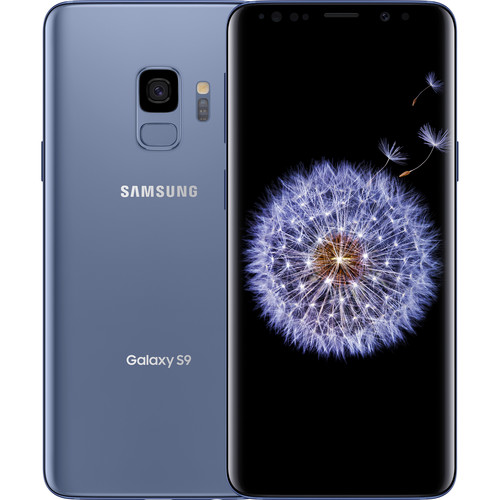
Samsung Galaxy S9 SM-G960U 64GB Unlocked Smartphone


Samsung Galaxy S9

See the light with the Samsung Galaxy S9 SM-G960U 64GB Unlocked Smartphone. Samsung's Dual Aperture feature is the hallmark of the S9, automatically switching based on lighting conditions. Built into the rear 12MP camera, Dual Aperture switches to F2.4 mode in daylight to take sharp and beautiful images and in low-light situations it goes to F1.5 mode to let more light in for brighter and clearer nighttime photos.
The S9's 5.8" Quad HD+ Super AMOLED Infinity Display goes edge-to-edge and curves over both sides so you have minimal visual distractions. The stunning 2960 x 1440 resolution combines with an epic 18.5:9 aspect ratio to give your videos a truly cinematic quality.
Running the Android 8.0 Oreo operating system, this phone is powered by a Qualcomm SDM845 2.8 GHz (2.65 GHz Quad + 1.7 GHz Quad) Octa-Core processor and 4GB of RAM. You can store your apps, AR emojis and Super Slow-mo clips on 64GB of built-in storage, which can be expanded via an (optional) microSD card up to 400GB in size.
This phone is unlocked and compatible with GSM/4G LTE networks. Connect to the internet and other devices with built-in 802.11 a/b/g/n/ac 2.4+5 GHz Wi-Fi and Bluetooth 5.0. The Galaxy S9 also supports NFC technology for making phone-to-phone data transfers or mobile payments.This phone is designed to work on select GSM and CDMA networks and is 4G LTE capable.

GSM + CDMA / 4G LTE Wireless Connectivity

LTE is an advanced cellular network data protocol capable of data speeds so fast that they compete with wired broadband Internet providers.
With an LTE connection, this phone should have no problem streaming HD video, downloading apps, uploading photos, or anything else that requires a high-speed data connection.
The phone is also backwards compatible with 3G and 2G data for instances when you can't get LTE. In addition to cellular wireless, this phone also features Bluetooth, NFC and Wi-Fi connectivity.

North American Variant / US Compatible LTE
To ensure this phone will work with your carrier please check to make sure the frequencies your carrier uses are supported by this phone.
The full list of compatible carrier frequencies can be found here, the frequencies this phone supports can be found in the product specs.

Dual Aperture

Samsung's Dual Aperture feature works like the human eye. In the dark, our pupil's open up to let more light in to help us see better and constrict when there's more light.
The rear lens of the S9's rear 12MP camera can automatically shift between an F2.4 and F1.5 aperture based on lighting conditions.
In low-light, it shifts to F1.5 to let more light in to give you brighter and clearer nighttime photos, with no fine-tuning required.
You can also take control of the situation by manually switching between the two apertures as you see fit.

Get Animated
Personalize your conversations with animated emojis based on how you look. With the S9, you can take selfies of different expressions and convert them into an animated version of yourself or who you want to be.
Change up the hair, glasses and clothes so they can share your personal style. You get 18 animated stickers of yourself automatically that show a wide range of emotion when chatting.

Superior Sound

We love to watch videos and listen to music with our phones and now with the S9, you can enjoy louder and crisper audio thanks to built-in stereo speakers specifically tuned by AKG.
It's pure sound that's 1.4x more powerful than previous Galaxy phones.The S9 takes mobile entertainment to new heights with the inclusion of Dolby Atmos technology, which gives you multi-dimensional sound that puts you in the center of a theater-like experience.
Intelligent Scan Security

Our phones capture our lives, so keeping them secure and locked is extremely important, which is why Samsung gives you six different methods to secure them.
In addition to the standard PIN, Password and Pattern methods of locking your phone, the S9 offers biometric methods that are tied to you and you alone.
For example, a built-in fingerprint scanner on the backside of the phone is conveniently located below the camera and is flush with the phone's back, giving you a quick and unique method of unlocking your phone.The S9 gets more high-tech with facial recognition and iris scanning. It's design to identify you in bright sunlight, low light and even if when you're wearing sunglasses.
Advanced Contrast Enhancement

See your photos as they were meant to be seen. View your photos and videos vividly on the S9's display. The contrast is increas when you're outside, so even in broad daylight you can see stunning detail on-screen.
Super Slow-mo at 960 FPS

The slower you go, the more epic those amazing, once-in-a-lifetime or hysterical moments can be in your video. Thanks to an enhanced speed sensor, the S9 is capable of slowing it down by shooting an incredibly fast 960 frames per second in HD resolution.
If you take an especially awesome Super Slow-mo shot, you can relive them on the S9's lock screen.Helping you make sure you get that perfect Super Slow-mo shot in one take is Samsung's Motion Detection feature. When on, a yellow square appears on the screen during a video and Super Slow-mo is activated for the entire video once motion is detected inside the square.
That level of control means less frustration and time wasted and more slow-mo videos to share online.
App Pair

In a plethora of cool features, this one is near the top for increasing your productivity. App Pair takes advantage of the S9's ability to do two things at once with split-screen and window-over-window capabilities.
You can setup your own App Pairs, which tie two apps together and store the icon on your homescreen or in the Edge panel.
Now, with the tap of a single icon, you can launch both apps at once and work on them in side-by-side.

Additional Features
  • Optical Image Stabilization
  • DeX compatible for using the S9 with a monitor, keyboard, or mouse
  • Samsung Knox for multi-level security designed from the chip up
  • Secure Folder gives you the ability to separate work information from personal
  • Wireless charging support with optional accessories
  • Expand your storage with optional microSD cards (up to 400GB)
  • Dolby Atmos technology for multi-dimensional sound
  • Turn Super Slow-mo videos into GIFs
  • Edit Super Slow-mo videos with music and 3 styles of looping
  • IP68 rating, so it can be submerg in up to 5' of freshwater for up to 30 minutes. It's also dust, dirt and sand resistant
  • Live translation of other languages in real time
  • Use AR and Bixby Vision for more info of the world around you

Dell 15.6" XPS 15 9560 Multi-Touch Notebook

The Dell 15.6" XPS 15 9560 Multi-Touch Notebook features a 15.6" InfinityEdge IPS display with a 3840 x 2160 resolution and 5.7mm thin bezels for your viewing pleasure. Driven by a dedicated NVIDIA GeForce GTX 1050 graphics card with 4GB GDDR5 VRAM, the XPS 15 is capable of handling multimedia playback and even games. Connect external displays using its HDMI and Thunderbolt 3 port for additional multitasking capabilities.

The system is powered by a 7th Gen Kaby Lake 2.8 GHz Intel Core i7-7700HQ quad-core processor. It also has 16GB of 2400 MHz DDR4 RAM, a 512GB PCIe solid-state drive, an SDXC card slot, 802.11ac Wi-Fi, Bluetooth 4.1, Thunderbolt 3, HDMI, and USB 3.0. Windows 10 Pro (64-bit) is the installed operating system. It includes all of the features of Windows 10 Home plus many designed specifically for businesses users, including Hyper-V virtualization, BitLocker disk encryption, and remote desktop access. Devices will also be able to join domains and the Azure Active Directory, and they can even access a specialized version of the Windows Store featuring custom, company-specific applications.

15.6" InfinityEdge Multi-Touch IPS Display
The XPS 15 features an InfinityEdge display with a 5.7mm bezel for a seamless and immersive viewing experience. Additionally, with a 3840 x 2160 4K UHD resolution, the XPS 15 offers crisp and clear visuals for your entertainment. Moreover, it features 100% minimum Adobe RGB, so you get a true representation of Adobe color that's rich, vivid, and bold. With the Dell's PremierColor application, webpages, videos, and images are automatically adjusted into Adobe RGB format for accurate colors.
Thunderbolt 3
Thunderbolt 3 is a hardware interface that utilizes the reversible USB Type-C connector. Doubling the speed of its predecessor, Thunderbolt 3 features a maximum throughput of 40 Gb/s when used with compatible devices. The connector also transmits data via USB 3.1 at up to 10 Gb/s, and dual-bandwidth DisplayPort 1.2 allows you to connect up to two 4K displays simultaneously. Additionally, you can daisy chain up to six devices from a single Thunderbolt 3 port.

Durable and Light
Built from a single block of aluminum for a sturdy, durable chassis, the XPS 15 also has a scratch resistant Gorilla Glass display. Furthermore, the palm rest is made from carbon fiber, which is strong, thin, light, and cool to the touch.
Start Menu
After its hiatus in Windows 8, the Start Menu has returned. Utilizing a combination of the traditional menu system and Windows 8's Live Tiles, the improved Start Menu gives you more information at a glance, showing notification information alongside your applications and other pinned items.
Cortana
Microsoft's digital personal assistant, Cortana can answer your questions with information gleaned from both your device and the internet at large. You can type or even talk with her, if your system has a microphone. Using her Notebook, Cortana keeps track of your needs and wants, and she learns over time to improve her information gathering skills.
Microsoft Edge
After nearly 20 years, Microsoft has finally replaced its Internet Explorer web browser. With Microsoft Edge, users can write directly on web pages and share notes with friends and colleagues. It also improves the online reading experience by adding a distraction-free mode and read-it-later functionality. Edge also has built-in Cortana integration; you can have her help you find a restaurant, make a reservation, and pull up directions without leaving your browser.

Windows Store
For Windows 10, Microsoft has unified the Windows Store. Now, apps for PCs, tablets, and phones will all be accessible from one place. And with support for Universal Apps, one version of an app can work across all your compatible devices automatically.
Windows Continuum
Windows 10 was designed for a variety of screen sizes and input styles, and with its Continuum feature, it automatically adapts to fit your needs. A Windows 10 tablet on its own requires a touch-centric approach, but attaching a mouse and keyboard will shift everything to a more traditional interface. You can even attach an external monitor to your Windows 10 phone for a near-desktop experience. But it's not just the operating system; Windows Universal Apps take advantage of Continuum as well.
Xbox on Windows 10
Gaming is a big focus of Windows 10. Xbox integration allows for PC players to match up against Xbox One players on supported games, and if you have an Xbox One, you can even stream compatible titles to your PC. Native support for recording with the new Game DVR feature makes it easy to capture and share your gameplay. The new DirectX12 takes better advantage of multi-core processors, giving games a performance boost, even on older hardware. Windows 10 also features native support for virtual reality headsets, such as the Oculus Rift.

OPPO Find X smartphone


Over the past few years, smartphone manufacturers have started designing devices with 
bigger displays and thinner bezels. One result is the switch from the traditional 16:9 aspect ratio to the now-trending 18:9 aspect ratio. Apple introduced the notch on its flagship iPhone X in order to make the screen as big as possible but still accommodate an earpiece and front camera in their usual spots, and a lot of Android manufacturers have followed suit. The notch has also become a popular feature, but now Vivo and Oppo have both showcased a new way to achieve a near all-display smartphone – moving parts.

Oppo Find X Design

The Oppo Find X has the ability to make you go ‘wow’ when you first see it. The face of this phone has thin borders all around the screen. The body has curves just like the Samsung Galaxy S9 and Galaxy S9 Plus. The back is also made of glass that curves at the edges which makes the phone easy to hold. Oppo sells the Find X in two colours, Bordeaux Red and Glacier Blue. Our review unit was the former option and it is stunning to look at. The use of glass on the back makes the phone a little slippery and one must exercise caution while using it. Oppo also ships a case in the retail box but we did not receive it with our review unit. The power button is on the right while the volume buttons are to the left. Apart from those, the sides are blank. There’s a USB Type-C port at the bottom, along with a speaker grill and a SIM tray.

Oppo Find X specifications, software, and features

Let’s first talk about the display, which is what makes the Oppo Find X look so appealing. The 6.4-inch AMOLED panel sports full-HD+ resolution and has vivid output. You can tweak the colour temperature and choose between natural or boosted colours. Since it is an AMOLED panel, the black levels are quite good. Brightness is adequate and the display is viewable outdoors. An always-on mode displays the current time and alerts for missed calls and messages.
At the heart of the Oppo Find X is the Qualcomm Snapdragon 845 processor which is as cutting-edge as it gets right now. It is an octa-core processor with eight Kryo 385 cores, of which four are clocked at 1.8GHz and the other four are clocked at 2.8GHz. To ensure that the processor does not face bottlenecks, the Find X has 8GB of RAM. It also gets 256GB of internal storage which is non-expandable. The Find X is a dual-SIM device and the two Nano-SIM slots are on either side of the tray, which is easy to miss at first glance. It has support for 4G and VoLTE on both SIMs.

Oppo Find X performance, battery life, and cameras

The Find X has powerful hardware giving it an upper hand in terms of performance. We did not notice any lag or stutter while scrolling through the menus and multi-tasking. With 8GB of RAM, the phone keeps quite a few apps in memory saving you from frequent reloading of content.
Oppo’s face recognition technology is good and failed to work only once across a period of four days. You need to swipe up from the lock screen to trigger face unlock or you can make the phone do that by simply pressing the power button. Since this smartphone uses a dot matrix projector that projects 15000 dots, and an infrared camera, it is capable of recognising faces even in pitch darkness. We tried this a couple of times at night and the phone did not disappoint us. The recognition process is quick but the camera module has to slide open each time, which means that there’s a delay.

Verdict

The use of movable parts to allow for a bezel-less display is a brave move by Oppo. The company has also done justice to this phone by using a vibrant AMOLED panel. This phone also isn’t only about showing off, as the Snapdragon 845 is the most powerful processor in Qualcomm’s stable at this point. With 8GB of RAM and 256GB of internal storage, it is in line with other flagships from leading brands.

Xiaomi Mi A1

Xiaomi Mi A1


The first of these in India was the Xiaomi Mi A1 which launched last year.
More manufacturers have enrolled into the program since then, but very few devices have made it to India. Nokia, an HMD Global brand, was the first to announce that its entire Android lineup would adopt Android One and all the smartphones that it announced at MWC 2018 have now launched in India. Xiaomi has now launched a successor to the Mi A1 called the Mi A2, and it promises better hardware while still running bone-stock Android. So should the Xiaomi Mi A2 be the first choice for an Android purist on a budget? We put it to the test.

Xiaomi Mi A2 design

The Mi A2 is a well-designed smartphone. It has a metal unibody that gives it a premium feel in the hand. The first change you will notice compared to the Mi A1 is that it has a big 5.99-inch display with an 18:9 aspect ratio, which makes the phone tall and narrow. The sides are curved which makes it comfortable in the hand. Our Black review unit had a matte finish which resisted fingerprints to some extent. This phone is quite slippery and we would recommend that you put the case supplied in the box to use.
The power and volume buttons are on the right and offer good feedback when pressed. We found that the power button is well placed, but the volume buttons are a little too high for our liking. Xiaomi has positioned the selfie camera, earpiece, selfie light and a notification light above the display while the space below it is blank. For those curious, this smartphone has a single-colour notification LED.
The USB Type-C port at the bottom has speaker grilles on either side but only the right one houses a loudspeaker. An IR emitter that can be used to control IR-based appliance is at the top along with the secondary microphone. There is no 3.5mm headphone jack so you get a USB Type-C dongle in the box. Xiaomi claims that it has used a high-quality amplifier to improve audio output from the speaker and headphones.

Xiaomi Mi A2 specifications, software, and features

The Chinese smartphone maker has chosen the Qualcomm Snapdragon 660 processor to power the Mi A2. It has eight Kryo 260 CPU cores and an Adreno 512 GPU. The A2 has 4GB of RAM and 64GB of internal storage. Sadly storage isn’t expandable unlike the Mi A1, and you will need to make do with the storage you get. This is a dual-SIM smartphone and has two Nano-SIM slots. There is support for 4Gand VoLTE on both SIMs.
The 5.99-inch display sports a full-HD+ resolution, has a pixel density of 403ppi, and uses Corning Gorilla Glass 5 for protection. Viewing angles are decent but the display does not get very bright. You don’t get the option to tweak the output. The Ambient Display feature wakes the phone when you get a notification.

Xiaomi Mi A2 performance and battery life

The Xiaomi Mi A2 offers similar performance and we found no lag or stutter when flipping through the phone’s UI and multitasking. With 4GB of RAM, you should be able to multitask easily without the phone automatically killing apps in the background. The fingerprint scanner is quite fast and was quick to unlock the phone.
The Xiaomi Mi A2 scored 1,33,467 in AnTuTu, and 1,645 and 4,840 in Geekbench 4’s single-core and multi-core tests respectively. These scores are slightly lower on average than those of the Nokia 7 Plus, which managed 1,37,573, 1,590 and 5,780 respectively. The Mi A2 also got 24,850 in 3DMark Slingshot Unlimited and 14fps in GFXBench Manhattan 3.1.
 We played games such as PUBG, Clash Royale, and Asphalt 9. PUBG ran at medium settings by default and we did not have any issues with performance. We played the game for 25 minutes, surviving an entire round, and found that the phone did get warm to the touch without getting uncomfortably hot. Asphalt 9 ran at the default settings without any hiccups either.

Xiaomi Mi A2 cameras

You get Short Video, Portrait, Square, Panorama, and a Manual mode, apart from the usual Photo and Video modes. The Manual mode lets you set white balance, focus, shutter speed and ISO, and also lets you choose between the ‘regular’ and ‘low light’ lenses. Xiaomi claims that it has tweaked the Portrait mode such that it uses the 12-megapixel camera in favourable light conditions but switches to the 20-megapixel camera in low light, but we found that this did not actually happen. While one lens is in use, the other acts as a depth sensor. 
The Mi A2 is fairly quick to meter light and lock focus. Photos taken with the Mi A2 outdoors have a good amount of detail and colours are quite accurate. Zoom into an image and you can still see details without much loss. We noticed that the camera app also switched HDR on automatically when the scene required it, bringing out more details from the shadows and delivering slightly sharper results. Autofocusing is quick when taking macros and we found that the Mi A2 could focus on relatively small objects. Macros were sharp and the phone managed good separation between the subject and the background.

Samsung Galaxy J8


Samsung has been in the smartphone race longer than most of its competitors. Naturally, the brand has a lot of recognition in India, such that people eagerly wait for each of its new phone announcements. One such smartphone is the Samsung Galaxy J8, which was launched recently in the sub-Rs. 20,000 segment.
With the Galaxy J8, the company is bringing the Infinity Display popularised by its S series of smartphones to the masses. The Samsung Galaxy J8 sports a big display with narrow borders, dual cameras at the back, and face recognition technology. But did Samsung cut any corners when designing the Galaxy J8? We find out.

Samsung Galaxy J8 design

The Samsung Galaxy J8 is a good-looking smartphone. It has a big 6-inch display with an 18.5:9 aspect ratio which makes the body tall and narrow. The 16-megapixel selfie camera is positioned above the screen along with a metallic earpiece and a single-LED flash. The space below the screen is blank, as the phone makes use of onscreen navigation buttons instead. Though Samsung uses the Infinity Display trademark, the screen on this phone doesn’t have curved sides like the ones on the Galaxy S9 (Review) and S9 Plus (Review).
Samsung has opted for a polycarbonate body, and it feels well-built. The phone weighs 177g but the weight has been well distributed. There’s a vertically oriented dual-camera setup at the back consisting of a 16-megapixel primary camera and a 5-megapixel secondary one. The fingerprint scanner is positioned right under the camera module, where your finger rests naturally.

Samsung Galaxy J8 specifications, software, and features

The Korean smartphone maker has succeeded in making a good-looking device, but the hardware inside could've been better. This smartphone is powered by an octa-core Qualcomm Snapdragon 450 processor clocked at 1.8GHz. We have seen the same processor powering the likes of the Xiaomi Redmi 5 (Review) which costs half as much as this phone. The Galaxy J8 has 4GB of RAM and a generous 64GB of storage, out of which around 51GB is available to the user.

Samsung Galaxy J8 performance, cameras, and battery life

The Samsung Galaxy J8 has enough power to deliver a smooth experience while scrolling through its UI. We did not see any lag or stutter when launching multiple apps and multitasking, except when we slide from the home screen to access Bixby. Samsung’s face recognition is slow to unlock the phone, and the fingerprint scanner isn't much better.


Verdict

The J series aims to offer the Samsung experience at a mainstream price point. The Infinity Display does grab eyeballs, and this phone feels solidly built. The front and rear cameras perform decently, and some of the features such as Chat over Video are useful if you really love to multitask. Battery life is the strongest weapon in the Galaxy J8’s arsenal.

Nepali Romantic Movie Bobby


New Nepali Movie

'Bobby' is a complete romantic Nepali family drama based on a real incident and revolves around a deeply-in-love couple and shows their love relationship, struggle and achievement. What's interesting about this project is that the movie will feature the same couple in lead on whom the film is being made. This is the first time in Nepali film industry's history that the real life characters are being shown as reel life couple.

Man United's Axel Tuanzebe returns to Aston Villa on loan


Manchester United defender Axel Tuanzebe has agreed to join Aston Villa in a season-long loan deal.
The 20-year-old will rejoin the Championship club after making five appearances on loan at Villa Park last season before an ankle injury ended his campaign.

Tuanzebe, who has made eight senior appearances for United, was part of Jose Mourinho's squad for the U.S. tour and featured as a second-half substitute during the defeat to Bayern Munich at the Allianz Arena on Sunday.

But it has been decide a temporary move to Aston Villa will be best for his development as he looks to make the step up into the first-team squad at Old Trafford.

Mourinho is already well-stock at centre-back with Eric Bailly, Phil Jones, Victor Lindelof, Chris Smalling and Marcos Rojo competing for places.

Sources have told ESPN FC that the Portuguese coach is keen to bring another central defender to the club before Thursday's transfer deadline.

Bayern's Jerome Boateng, Tottenham's Toby Alderweireld and Leicester's Harry Maguire are all potential targets.

If one arrives by Thursday, it is likely Rojo will be allow to move on with Everton leading the race for the Argentinian's signature.

Will go on another hunger strike if govt fails to honour agreement: Dr KC

Dr. Govinda K.C.

Medical activist and senior orthopaedic surgeon Dr Govinda KC, who got discharged after treatment at Tribhuvan University Teaching Hospital following 27 days of hunger unto death, organised a press meet today.
At the presser, the medical activist expressed hope that the government will honour the nine-point agreement signed by him and the government representatives for reform in medical education.
It has been 13 days since the government and Dr KC reached the deal. Prime Minister KP Sharma Oli had assured that the Medical Education Bill would be passed at the Parliament and that nobody would have to go on such strikes again.
Dr KC further went on to say that he will be compelled to go on another hunger-strike should the government fail to implement the agreement.
KC reminded the Prime Minister and the government of their promises and urged them to work to fulfil the same at the earliest possible.

Nepal win first ODI in last-over thriller

Aug 4, 2018-Nepal secured a historic victory in their first-ever One Day International (ODI) Series beating the Netherlands by one run in a last over thriller to level the two-match affair 1-1 at the VRA Grounds in Amstelveen on Friday.
Nepal, having won the toss, decided to bat first on a sunny day in Amstelveen.
Nepal’s batsmen looked to dominate the Dutch bowling attack from the beginning, but the hosts continued to take wickets at regular intervals.
But it was pacer Sompal Kami who rescued the innings to push Nepal’s score past 200 with his well calculated 61. Nepal could only muster 216.
Needing six runs to win from the last over bowled by Khadka, Klaassen took a single in the first ball before Van Meekeren played a dot in the second.
Meekeren scampered for a single in the third ball and the Dutch needed two to win from the last two when Klaassen managed a couple in the fourth.
Khadka kept a dot in fifth ball and in the dramatic last ball Klaassen hit straight to the stumps and ran for a single which could have at least tied the match. But Khadka uprooted the stumps to create history.
It was skipper Paras who claimed the last Dutch wicket to wrap up the Dutch innings and complete Nepal’s first victory in ODI cricket in the final ball of the match.
The Dutch needed two runs of the final ball but a quick Paras Khadka ran the last Netherlands pair out to register a one run victory for Nepal.
Roadies’ Wild Wild West avatar

The second iteration of the hit reality series Himalaya Roadies — The Nepali edition of the Indian reality TV show MTV Roadies—has roared off with the first episode airing across the nation. This edition of the Himalaya Roadies, dubbed Wild Wild West, began with the airing of the Chitwan audition round of the show
MTV Roadies, has proven to be one of the biggest reality shows in South Asia, with thousands of contestant and audiences.
In the show, a group of contestants travel to different destinations and participate in various tasks that challenge their physical and mental strength. During the course of the journey, there are vote outs, vote ins, eliminations and game changing twists. Eventually, the contestant who manages to survive vote outs and succeeds in the final task is chosen as the winner.
Envisioned in the same format, Himalaya Roadies this season will again travel to five different cities where aspiring contestants will be vetted by returning judges Lauhre (Asish Rana), actor Deeya Maskey and media personality Raymon Das Shrestha.
This year, the show will also see the return of last year’s finalists Saman Shrestha and Animesh Shahi as the show’s hosts.
For the first of 18 episodes, the contestants who flocked to the Chitwan auditions held in April this year were put through a series of grueling tests, before 12 select contestants faced the three judges in one-on-one sessions. Eventually, three contestants—Men Kumari Ghale, Subha Sharma and Sagar Raj Rijal--were selected to continue on in the show.
Himalaya Roadies is a part of the Roadies franchise licensed by Viacom 18, and airs every Monday at 8pm on Himalaya TV, with an additional half-an-hour ‘behind the scenes’ segments airing after the episode.


Nepal’s historic game

Nepal blew away a solid chance to win their first ever One Day International match losing to Netherlands by 55 runs in the first of the two-match ODI series at the VRA Grounds in Amstelveen on Thursday.
Skipper Paras Khadka picked up four wickets in a tight bowling display to restrict the Netherlands to 189 all out in 47.4 overs. 
Openers Gyanendra Malla and Anil Sah gave Nepal a modest start with a half century stand but the middle order failed to make the most of it that was already dealt a blow due to the injury to middle order mainstay Sharad Vesawkar. Vesawkar came in to bat at No 11 and his dismissal saw Nepal bundled out for just 134 runs in 41.5 overs.
“We didn’t actually made the most of opportunity,” said Khadka. “Restricting them to below 200 was a good really good performance. We should have done better in batting, including myself. We always complained about not getting good start from the openers but we broke the poor trend today. But could not capitalise on the opportunity provided by the openers”
Gyanendra put on 58 runs for the first wicket with Anil Sah (21) before the latter fell to Fred Klaassen. Malla completed his half century in 57 balls and then saw skipper Khadka (12) lose wicket to his opposite number Pieter Seelaar.
 Malla was trapped leg before by Michael Rippon as the opener headed back to the pavilion making a 61-ball 51 with eight hits to the fence. Nepal then went through a mini collapse losing Aarif Sheikh, Sompal Kami and Basanta Regmi as all three batsmen fell for ducks.
Dipendra Singh Airee hung around with retiring Shakti Gauchan before falling to Fred Klaassen. Airee was the second best scorer for Nepal making 48-ball 33 with two fours and a six. Vesawkar came in to bat at No 11 braving his finger injury but with just a wicket left had already slipped put of Nepal’s grasp. Vesawkar is out of the Friday’s match as well. Michael Rippon (3-23), Pieter Seelar (3-20) and Fred Klaassen (3-30) shared nine wickets to sink Nepal.
Earlier, it was Khadka who strangulated the Dutch batting lineup with accurate line and length. Seamer Sompal Kami provided the first breakthrough removing opener Daniel Ter Braak (one) in the third over. Ben Cooper (20) and another opener Stephan Myburg steadied the Dutch innings with a 45-run stand for the second wicket before Khadka trapped the latter leg before wicket. 
Young leg spinner Sandeep Lamichhane joined the act clean bowling Myburg for a 32-ball 29 that included four boundaries and a six.
Khadka soon reduced the Netherlands to 72-4 getting Wesley Barresi (12) caught at mid on by Aarif Sheikh. Bas de Leede and Michael Rippon then rebuilt the Netherlands innings with a 68-run partnership for the fifth wicket. Sompal provided the much needed breakthrough having De Leede caught behind by wicketkeeper Anil.
De Leede made 30 off 60 with a six and a four. Basanta Regmi took his first ODI wicket following a sharp catch from Shakti Gauchan, who was probably played his last match outside Nepal. Shakti gave a quick reflex to take a sharp one-handed catch of Dutch skipper Seelaar who tried to sweep Regmi in a ball that kept pretty low.
The big wicket came in the 40th over after Khadka had Rippon caught by Dipendra Singh Airee. Rippon made 51 off 76 balls with two boundaries. One ball later he bowled Shane Snater for two-ball duck reducing the hosts to 159-8. The Dutch tail order offered a brief resistance taking the team to 189. Khadka returned with figures of 4-26 from 10 overs, while Sompal also took three wickets for Nepal. Sandeep Lamichhane, Basanta Regmi and Karan KC also had one scalp apiece.
Summary
Netherlands 189 in 47.4 overs (M Rippon 51, De Leede 30; P Khadka 4-26, S Kami 3-34) beat Nepal 134 in 41.5 overs (M Rippon 3-23, D Airee 33, F Klaassen 3-30, G Malla 51, P Seelaar 3-20) by 55 runs
Man-of-the-match: M Rippon

Rupendehi

Rupandehi District a part of Province No. 5, is one of the seventy-seven districts of Nepal covers an area of 1,360 km². The district headquarter is Siddharthanagar. As per the national census 2011, the population of Rupandehi was 880,196.

Etymology

Rupandehi is named after Rupadevi, the queen of King Suddhodana.

History

Lumbini, birthplace of Lord Buddha, lies in Rupandehi district. Devdaha, the birthplace of Mayadevi (mother of Lord Buddha) also lies in Rupandehi district.

Demographics

At the time of 2011 A.D National population and Housing census 2011 was reported that total population of Rupandehi district was 880,196 . and Male=432,193 and Female=448,003 and total household was 163,916 . Data Source: Central bureau of statistics Kathmandu, government of Nepal .
Residents are mainly Magars and Tharus. In some southern villages there are a few Bhojpuris.

Geography

The district lies on the southern and western part of Nepal. On the East it shares border with Nawalparasi District, on West with Kapilvastu District, on North with Palpa District and on South with India.The elevation of the district lies between 100m to 1229m from sea level. The total area of the district is 1,360 km² with 16.1% in Churia Range and rest in the Terai region.

Major Rivers

Rupandehi has many rivers all of which flow from Northern mountains towards south into India.
  • Tinau River
  • Kothi River
  • Sukhaira River
  • Bagela River
  • Rohini River
  • Kanchan River
  • Kacharar River
  • Koili River
  • Danav River
  • Danda River
  • Ghodaha
  • Khadawa

Major Lakes

  • Gaidahawa lake (Bishnupur)
  • Gajedi lake (Gajedi)
  • Nanda vauju lake (Chilhaiya)
  • Sukaiiya lake
  • Climate

    Climate Zone]Elevation Range% of Area
    Lower Tropicalbelow 300 meters (1,000 ft)89.3%
    Upper Tropical300 to 1,000 meters
    1,000 to 3,300 ft.
    10.5%
    Subtropical1,000 to 2,000 meters
    3,300 to 6,600 ft.
     0.2%

    Notable events and attractions

    PRAKETESHWAR MANDIR
    This Mandir is near of Lumbini road.many people visit there to worship God PRAKETESHWAR or SHIVA throughout the year.it is the most popular temple after Rupandehi in this are

    Nawa Durga Bhawani Mandir

    It lies in Sainamaina-3, Murgiya. Many peoples visit there to worship Goddess Durga throughout the year. It is the most popular Temple after Parroha Temple in this area.Many poojas are conducte timely. It is regularly repaired by the members involved in its development.

    Lumbini

    Birth place ofGautam Buddha
    Lumbini is the birthplace of Lord Buddha on whose teachings Buddhism was founded. It is granted World Heritage status by UNESCO in 1997. Thousands of Buddhist monks, pilgrims and tourists visit Lumbini annually. The ongoing up-gradation of Gautam Buddha Airport into international airport is expected to increase the number of visitors. Mahinda Rajapakshe, President of Sri Lanka is one of the high-profile visitor of Lumbini.

    Parroha Bol Bam Dham

    It is the oldest Bol Bam Dham (pilgrimage and festival) in Nepal. The pilgrimage is dedicated to Lord Shiva located in Sainamaina Municipality. Thousands of Lord Shiva's devotees from various parts of the country and from neighboring States of India visit to worship the Shivalinga inside the Bol Bam Dham. The major inflow of pilgrims occurs during the Bol Bam. Bol Bam is an annual pilgrimage glorifying the Lord made in Shraavana in which devotees travel barefooted wearing saffron robes in routes to the dham.

    Siddha Baba Mandir

    Siddha Baba Temple
    This is a temple dedicated to Lord Shiva situated in border between Palpa and Rupandehi. There is a belief that Lord Shiva grants the wishes of the devotees who visit the temple. There are two Siddha Baba Mandir adjacent to each other. One lies within Rupandehi and another in Palpa. Nonetheless, both Mandir are regarded as pilgrimage of equal importance.

    Satiya Mai Mandir

    This is a temple dedicated to Devi Satiya situated in Patkhauli VDC, near Rohini Khola In Rupandehi. There is a belief that Real Lady grants the wishes of the devotees who visit the temple. There are a real Maya Devi Mandir and other is modified temple adjacent to each other. One lies within Rupandehi and another in Palpa. Nonetheless, both Mandir are regarded as pilgrimage of equal importance. Due to the Godes beloved to visitor's in Satiya Ban area. Actually this temple is situated in the middle of Rohini Khola but now River is flowing west of Satiya Devi Temple and Satiya Bagaicha.

    Manimukunda Sen Park

    Once a winter palace of King Manimukunda Sen, Manimukunda Sen Park is another major attraction in Rupandehi. The palace is not in shape but the ruins and antiquities of the majestic palace can still be found. It is situated in Butwal City and is popular for the picnic spots, zoo and the gardens inside the park. The greenery and the view of Rupandehi, Palpa and Kapilvastu districts is also another attraction in the park.

    Shankar Nagar Ban Bihar and Research Center

    Shankar Nagar Ban Bihar and Research Centre, simply referred as Ban Batika by locals is a popular attraction in Tilottama Municipality. The Centre is maintained inside Shankarnagar Community Forest. It is popular for its picnic spots, zoo and garden.
    • Chanchala Mai Mandir
    • Jitgadhi
    Marchwari Devi Temple: Marchwari Devi Temple lies in Bogadi VDC of Rupandehi. It is a historical temple among the 24 previous VDC. The area surrounding this temple (now 18 VDCs) are named after this temple as Marchwar. The local people and peoples from INDIA, Uttar Pradesh visit there on specific occasions to celebrate child birth, engagement and marriage ceremonies visiting beautiful places. Temple is located in a peaceful area.The most peace fultemple is peace park.

    Major economic centers

    • Butwal
    • Siddharthanagar (Bhairahawa)
    • Lumbini ( world Heritage Area, as tourism )
    • Dhakdhai ( industry area )
    • Devdaha ( miroduct area )
    • Sainamaina (Murgiya for sports and tourism)
    • Murgiya
    • Manigram
    • Bhalwari
    • Manglapur
    • Bashgadi
    • Jogada
    • Divertole
    • Sankarnagar
    • Jogikuti
    • Thute pipal
    • Chho.gen Never ( Grain Products area )
    • Kothihawa
    • Lumbini
    • Saljhandi
    • Sauraha Pharsatikar
    • semlar
    • marchawar
    • SEMARI Industrial AreaAdministrative divisions
      Municipalities and VDCs in Rupandehi
      Sr. No.NameDivisionHouseholdPopulation
      1ButwalSub-Metropolitan City29,662118,462
      3DevadahaMunicipality6,43528,214
      4Lumbini SanskritikMunicipality833161157
      5SainamainaMunicipality10.07345,178
      2SiddharthanagarMunicipality32,497163,483
      6TilottamaMunicipality1967989815
      7AamaVDC161511340
      8Paschim AmuwaVDC219211231
      9AsurainaVDC10517249
      10BagahaVDC7075228
      11BagauliVDC14299780
      12BairghatVDC7426058
      13BasantapurVDC12058163
      14BetakuiyaVDC7135046
      15BishnupuraVDC223114390
      16BodawarVDC12778460
      17BogadiVDC147310634
      18ChippagadhVDC8585221
      19Chhotaki RamnagarVDC8735352
      20ChilhiyaVDC9605514
      21DayanagarVDC17699229
      22DhakadahiVDC11046965
      23DhamauliVDC8406285
      24PharenaVDC6354387
      25GajediVDC251712423
      26GonahaVDC194413760
      27HarnaiyaVDC7464858
      28Hati BangaiVDC12477954
      29Hati PharsatikarVDC8054929
      30JogadaVDC8926102
      31KamahariyaVDC277919157
      32KarautaVDC148711459
      33Khadawa BangaiVDC15558746
      34MainahiyaVDC11257634
      35MajhagawaVDC8515606
      36ManmateriyaVDC14509446
      37ManpakadiVDC11486783
      38MaryadapurVDC8195663
      39MotipurVDC225910198
      40PadsariVDC198810039
      41PajarkattiVDC7765081
      42Sakraun PakadiVDC7315528
      43PatakhauliVDC9165708
      44PokharvindiVDC9356220
      45RayapurVDC156811834
      46RoinihawaVDC6425399
      47RudrapurVDC456720649
      48SadiVDC9506300
      49SaljhandiVDC231910644
      50Semara MarchawarVDC9727946
      51SemlarVDC217610082
      52SiktahanVDC184310570
      53SilautiyaVDC12949216
      54SipawaVDC9777517
      55Sauraha PharsatikarVDC19929663
      56SuryapuraVDC321220773
      57Tamuhawa PiparhawaVDC5924765